
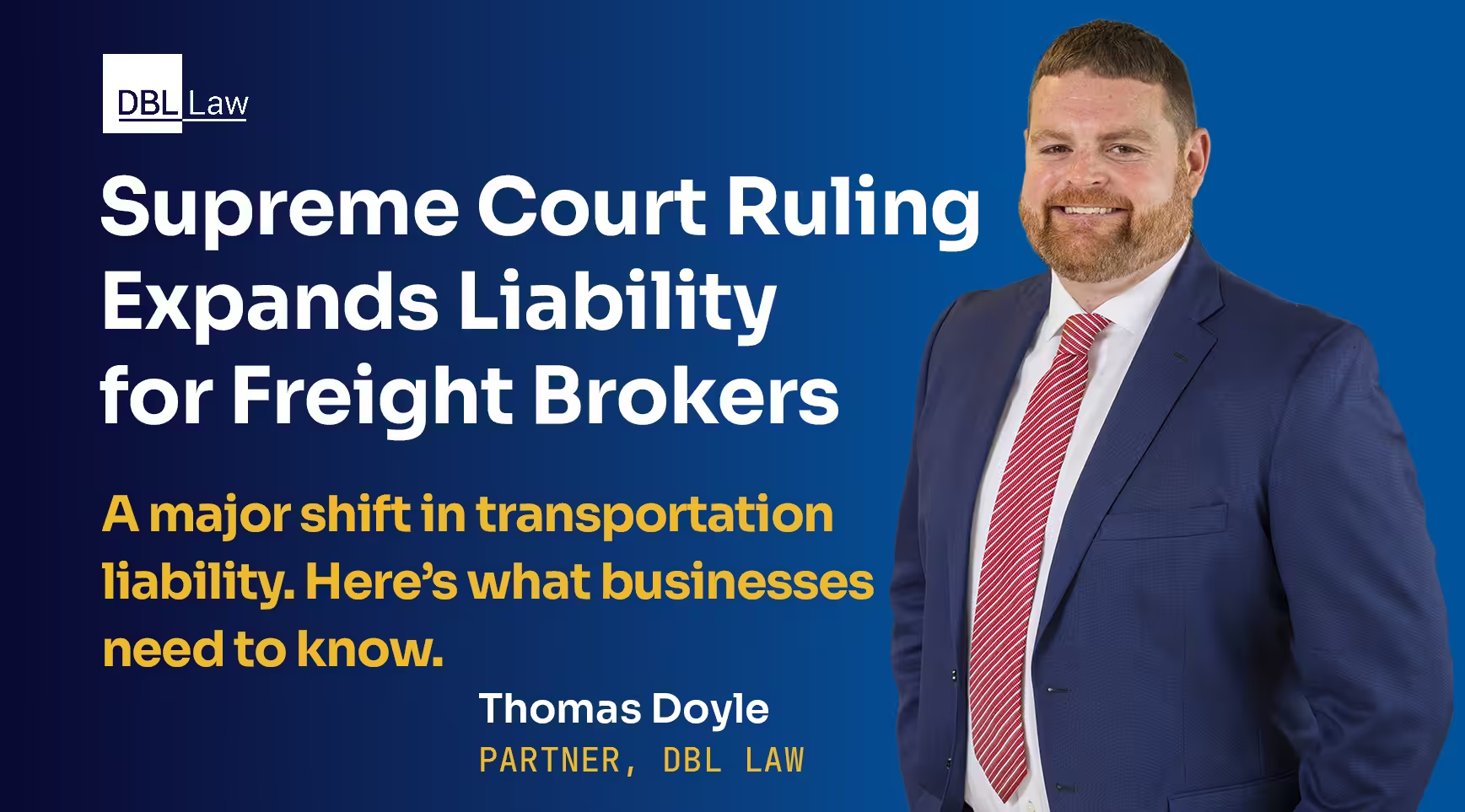

The U.S. Supreme Court has issued a unanimous decision that could significantly alter risk exposure for freight brokers, third-party logistics providers, and others involved in carrier selection.
In Montgomery v. Caribe Transport II, LLC, the Court held that federal law does not shield freight brokers from state-law negligent hiring claims when a broker allegedly selects an unsafe motor carrier that later causes a serious accident.
For the transportation and logistics industry, this is not a minor procedural development. It is a meaningful shift in liability exposure and operational expectations.
What Happened?
The case arose from a catastrophic trucking accident in Illinois in which the plaintiff suffered severe injuries after being struck by a commercial truck. The injured party alleged that freight broker C.H. Robinson negligently selected the motor carrier involved despite publicly available warning signs about the carrier’s safety history.
The central legal question was whether the Federal Aviation Administration Authorization Act (FAAAA), which broadly preempts certain state laws affecting broker services, barred these types of negligence claims.
The Supreme Court said no.
Writing for a unanimous Court, Justice Amy Coney Barrett concluded that state negligence claims tied to motor vehicle safety fall within the FAAAA’s “safety exception,” meaning they are not federally preempted.
Why This Matters
For years, freight brokers have often relied on federal preemption arguments as a defense against negligent hiring claims arising from crashes involving contracted carriers.
That defense is now significantly weakened.
The practical takeaway is straightforward: freight brokers may now face increased scrutiny regarding how they vet and select carriers, particularly when safety data is publicly accessible.
This ruling may also extend beyond traditional freight brokers.
Third-party logistics companies, transportation intermediaries, and entities involved in arranging freight movement should carefully evaluate whether their carrier selection practices could invite similar claims.
Immediate Business Implications
1. CARRIER VETTING JUST BECAME MORE IMPORTANT
If your organization’s carrier qualification process is informal, inconsistent, or poorly documented, this decision should prompt immediate review.
Questions worth asking include:
- Are FMCSA safety records routinely reviewed?
- Are out-of-service rates or safety alerts part of selection criteria?
- Is carrier approval centralized or decentralized?
- Is the decision-making process documented?
A reasonable process matters. A documented reasonable process matters even more.
2. Insurance Coverage Should Be Reviewed
Organizations should assess whether their current insurance program adequately addresses negligent hiring or intermediary liability claims.
Coverage assumptions that made sense under a stronger preemption landscape may no longer hold.
3. Contract Language May Need Updating
Broker-carrier agreements, indemnity provisions, and risk allocation language deserve renewed attention.
Contract protections are not a substitute for sound operational practices, but they remain an important layer of risk management.
4. LITIGATION RISK LIKELY INCREASES
Plaintiffs’ attorneys will almost certainly view this ruling as an invitation to pursue additional claims against brokers and intermediaries with deeper pockets than smaller carriers.
That does not mean every claim succeeds.
It does mean more claims are likely to survive early dismissal.
A BROADER INDUSTRY SIGNAL
The Court’s decision reflects a broader principle that economic deregulation does not necessarily eliminate traditional tort liability where public safety is implicated.
For transportation businesses, this is a reminder that operational decisions are increasingly being examined through a risk management lens, not simply a commercial one.
Speed and pricing remain important in logistics.
But after this decision, safety diligence in carrier selection may carry greater legal consequences than ever before.
How DBL Law Can Help
Transportation and logistics clients should consider a proactive legal and operational review of:
- Carrier vetting protocols
- Broker agreements
- Indemnification provisions
- Insurance coverage alignment
- Internal documentation procedures
- Litigation preparedness strategies
DBL Law’s Commercial Trucking & Transportation attorneys help clients assess operational exposure, strengthen contractual protections, and respond strategically to evolving liability risks. Contact Tom Doyle or a member of DBL Law’s Commerical Trucking & Transportation Practice Group to learn more.