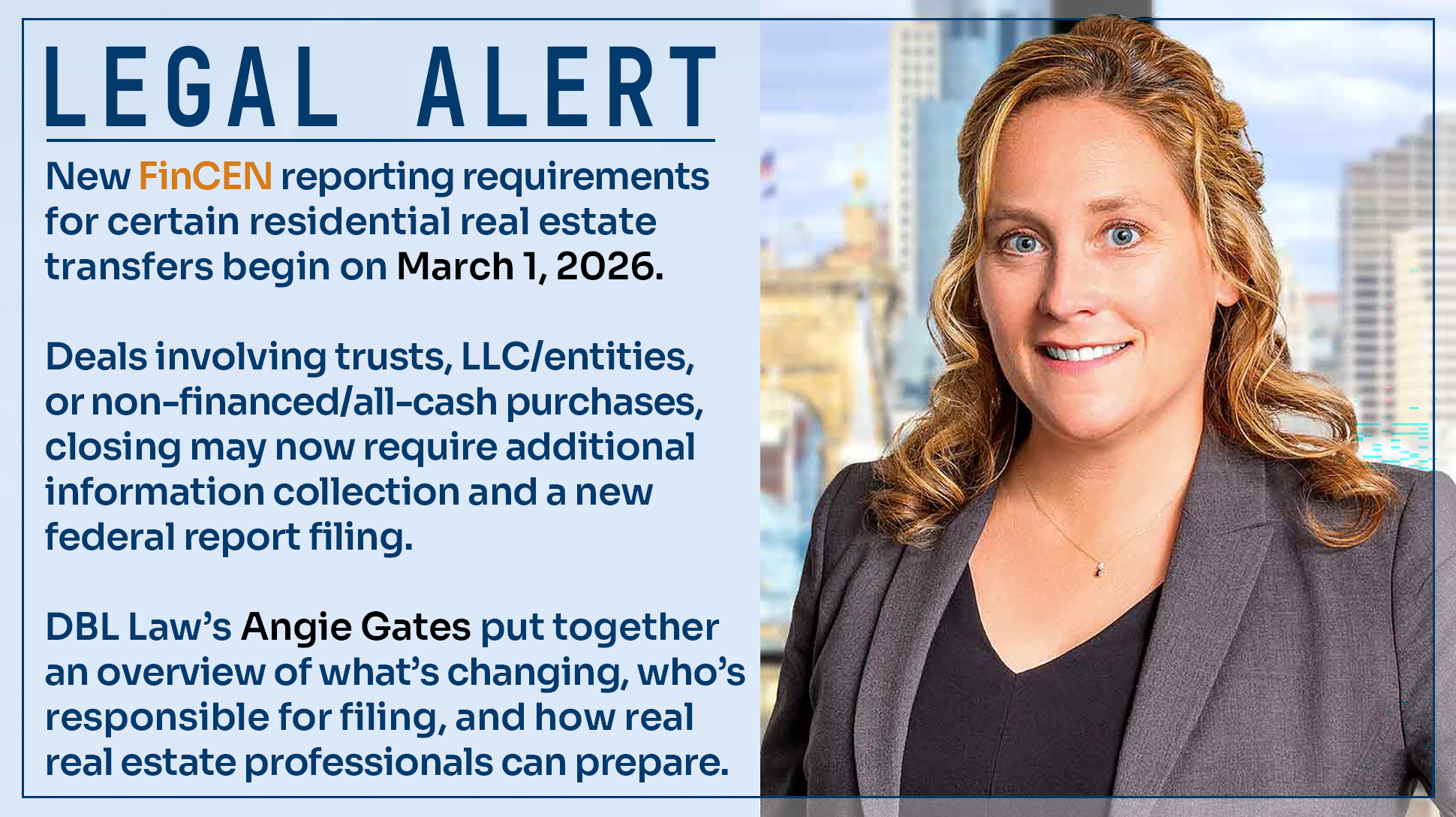

Starting March 1, 2026, a new federal reporting rule will change what information must be collected and submitted in certain residential real estate transactions—especially all-cash (or otherwise “non-financed”) purchases involving trusts and entities. The rule comes from the Financial Crimes Enforcement Network (FinCEN) and is designed to increase transparency in transactions that can be attractive for money laundering and other illicit finance activity.
For many deals, the closing process won’t look dramatically different. But for transactions that fall within the rule, the parties involved—particularly those coordinating closing and settlement—should be prepared to gather additional information, confirm responsibility for filing, and build a little extra time into the workflow.
Below is a practical overview of what’s changing and how real estate professionals can prepare.
What’s Changing on March 1
Beginning March 1, 2026, a Real Estate Report must be filed for any “reportable transfer” that closes on or after that date.
In plain terms, FinCEN is targeting transactions that share three common features:
- Residential real estate (generally one-to-four family residential property, vacant property intended to be used as a residence, and certain similar residential interests)
- A buyer that is not a natural person (for example, an LLC, corporation, partnership, or a trust)
- No traditional bank mortgage tied to the purchase (i.e., the transaction is “non-financed” for purposes of the rule)
Why this category? When property is purchased through an entity or trust—and especially when a bank isn’t involved—there may be less standardized customer due diligence. FinCEN’s reporting requirement is meant to close that gap by ensuring key details are captured and available to law enforcement when needed.
Transactions Most Likely to Trigger Reporting
While the rule has definitions and exceptions that matter in the details, the transactions most likely to be impacted in day-to-day practice include:
- All-cash purchases where the buyer is a trust (revocable, irrevocable, land trust, and certain other trust structures)
- All-cash Purchases by LLCs or other entities
- Cash transactions with contract assignments into a trust or LLC shortly before closing
- Transactions funded through private lenders / hard money (not subject to bank AML oversight)
If you regularly work on transactions where purchasers use trusts or entities for privacy, estate planning, liability management, or investment strategy, it’s worth assuming these new steps will show up more often than you think.
Who Files the Report
In most cases, the “reporting person” will be the party providing closing or settlement services (often the title/settlement agent associated with the transaction). Practically, that means the professionals closest to closing logistics are likely to carry the filing obligation.
However, it is possible to designate another Reporting Party under the rule upon execution of a proper Designation Agreement.
What Information Will Be Reported
The Real Estate Report is designed to capture a clearer picture of:
- Who is buying (including the trust/entity and key individuals connected to it)
- Who is selling
- The transaction details (property address/legal description, closing date, purchase price, and payment method)
- Certain information relating to beneficial ownership / control for trusts and entities, depending on structure
For trust-based transactions, that can mean collecting information about parties such as a trustee, grantor, beneficiary, trust protector, and any individual with authority to control decisions on behalf of the trust.
When the Report Is Due and How Long Records Must Be Kept
FinCEN’s deadline is intentionally flexible, but it still matters for workflow planning:
- The Real Estate Report must be filed by the last day of the month following the month of closing, or 30 days after closing—whichever is later.
- The reporting party must retain a copy for five years.
This generally gives the reporting person 30–60 days after closing, but the information collection needs to happen before closing—because missing or incomplete information can delay submission and create post-closing friction.
Practical Steps Realtors and Deal Teams Should Take Now
The firms and professionals who handle this well will be the ones who make reporting a repeatable process, not a last-minute scramble. A few concrete steps that can help:
1) Identify trust/entity buyers early
At first meaningful contact, determine whether the buyer is an individual or a trust/entity and flag the file accordingly.
2) Add a standardized questionnaire
Consider incorporating a short trust/entity intake form into onboarding so the deal team knows what documents and information may be needed.
3) Confirm responsibility for filing
If reporting is required, get written confirmation of who will file (title/settlement, attorney, or other designated party).
4) Gather core trust documentation sooner, not later
Many trusts can provide a Certification/Memorandum of Trust sufficient to identify key parties without disclosing the full trust instrument.
5) Coordinate on payment method details
Because payment method is part of what gets reported, build in a process to confirm whether funds will arrive by wire, cashier’s check, crypto, or another method—and document it.
6) Set expectations with clients
Trust and entity buyers often use those structures for privacy or planning—not wrongdoing. The best path is transparency: explain that the rule is federal, standardized, and the information is reported to FinCEN as part of anti-money laundering oversight.
How DBL Law Can Help
If you are a realtor, broker, title professional, developer, investor, or attorney working in this space, now is a good time to pressure-test your workflow:
- Does your intake process reliably identify reportable transfers?
- Do you have a consistent way to collect and document trust/entity details?
- Do you know who will file when multiple professionals are involved?
- Do your closing timelines allow room for additional information gathering?
Our Real Estate team can help you interpret the rule’s scope, integrate compliance steps into your process, and avoid closing delays—especially for transactions involving trusts, entity purchasers, private financing, or complex payment structures.