
The Story Off the Court: Why the Suns’ Policy is Making Headlines
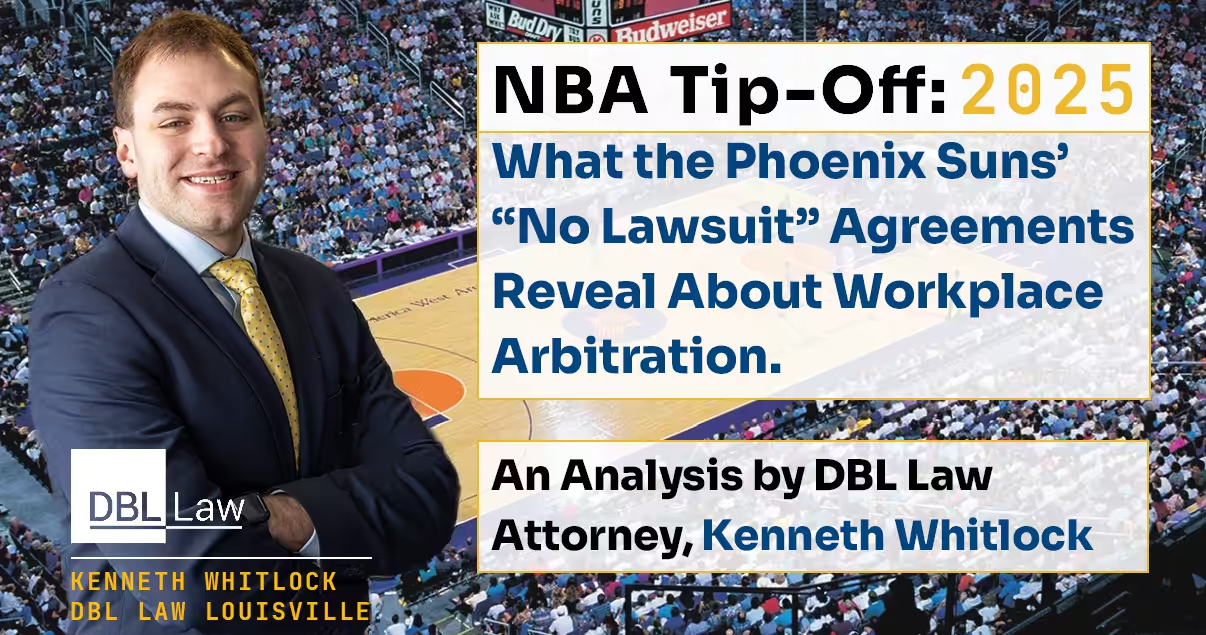
As the NBA season tips off, the real drama for the Phoenix Suns isn’t on the hardwood—it’s in the employee handbook.
The news broke recently that the Suns reportedly told their current and former employees they needed to sign agreements limiting their right to sue the team, or risk losing their jobs. These are known as mandatory arbitration or dispute-resolution agreements.
What does that mean? Instead of settling workplace disputes (like claims of discrimination, retaliation, or wrongful termination) in a public courtroom with a jury, the matter is moved to private arbitration.
While proponents argue arbitration is faster and more confidential, employee advocates often worry it lacks transparency and restricts an employee’s right to a public trial.
The situation with the Suns is particularly controversial because of how the agreement was introduced. In May 2025, employees received a revised handbook that included a new, four-page “Confidential Information, Intellectual Property, and Dispute Resolution Agreement.” In addition, employees were reportedly given just three days to review and consent to the complex new terms.
Many legal critics immediately argued that it pressured employees to waive significant legal rights with minimal notice. The Suns defended the policy as a “standard” practice for large organizations, but the controversy highlights the massive stakes: the team has faced multiple lawsuits since October 2024 alleging harassment, discrimination, and wrongful termination.
Your Rights: The State-by-State Playbook for Arbitration Agreements
For both employers and employees in the Midwest, this high-profile case raises a critical question: Can my employer require me to sign an arbitration agreement after I’ve already been hired?
The answer is complex and depends heavily on state law. Here is a breakdown for Indiana, Ohio, and Kentucky:
Indiana
- The Law: Courts in Indiana are generally employer-friendly. They allow employers to require existing at-will employees to sign new agreements, including arbitration clauses, as a condition of continued employment.
- The Key: In Indiana, the simple act of allowing you to keep your job is considered “valid consideration”—it’s the benefit that makes the agreement binding, even if you don’t receive a raise or bonus.
- The Warning: Refusing to sign an otherwise lawful agreement in Indiana could lawfully result in termination.
Ohio
- The Law: Ohio also recognizes continued employment as sufficient consideration to make a mid-employment arbitration agreement binding.
- The Nuance: While employer-friendly on the concept, Ohio courts also scrutinize the terms of the agreement itself. They will look for fairness and reasonableness, often striking down overly broad, one-sided, or “unconscionable” clauses.
- The Takeaway: Employees should check that the agreement covers disputes appropriately and doesn’t impose unreasonable obligations on them.
Kentucky
- The Law: Kentucky’s legal landscape has evolved. Following a 2019 legislative change to KRS 336.700, employers can now require employees to sign arbitration agreements as a condition of continued employment.
- The Critical Requirement: The statute explicitly requires mutuality of obligation. This means if the employee must arbitrate their claims against the employer, the employer must also be bound to arbitrate their claims against the employee.
- The Best Practice: While it’s permitted, employers in Kentucky often provide an additional benefit (like a bonus or a small raise) to strengthen the agreement and ensure it’s seen as validly supported by “consideration.”
Need Guidance on an Employment Agreement?
Arbitration clauses and employment contracts are high-stakes documents for both employees protecting their rights and businesses managing risk.
If you are dealing with an arbitration agreement, employment contract, or workplace policy in Indiana, Ohio, or Kentucky, the experienced Employment Law team at DBL Law can provide guidance.
We offer:
- Reviews of agreements for enforceability and risk.
- Drafting and revising workplace policies.
- Advice to employees on their rights and options.
Contact DBL Law today for practical, experienced counsel tailored to your state and situation.