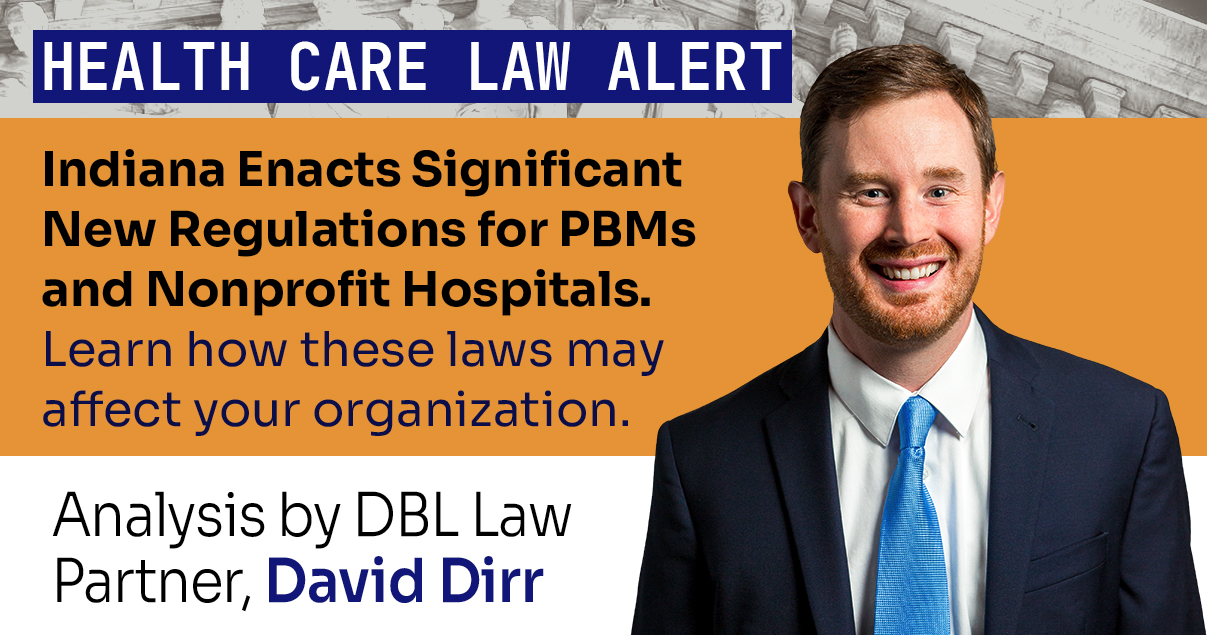

Two major pieces of healthcare legislation passed in Indiana earlier this year.
Senate Bill 140: PBM Reform with Broad Implications for Employer Plans
Signed into law by Governor Braun on May 6, 2025, Senate Bill 140 (SB 140) represents one of the most comprehensive reforms of pharmacy benefit managers (PBMs) in Indiana to date. The law takes direct aim at several longstanding practices that have limited employer flexibility and patient choice.
Most notably, SB 140 prohibits insurers and third-party administrators (TPAs) from requiring employer plans to contract with a particular PBM—particularly those that are affiliated with the insurer or TPA. Under current practice, employers that seek a “carve out” from the default PBM arrangement often face substantial administrative fees. Beginning with plan years on or after January 1, 2026, those restrictions and associated fees will no longer be permitted. This change will give Indiana employers greater freedom to select the PBM that best aligns with their goals, regardless of who administers their health plan.
The law also introduces stronger pharmacy network adequacy standards, mandating that insured individuals have access to a non-mail-order pharmacy within 30 miles of their residence, assuming one is available. Furthermore, PBMs are barred from entering into contracts that limit pharmacists’ ability to advise patients about lower-cost prescription alternatives.
Insurers and PBMs will now be subject to annual reporting requirements to the Indiana Department of Insurance, which is tasked with enforcing network adequacy and communications accuracy.
House Bill 1004: New Requirements for Nonprofit Hospital Pricing
While SB 140 directly affects employer-sponsored health plans, another new law—House Bill 1004—will create an additional burden for Indiana’s nonprofit hospitals.
Under HB 1004, nonprofit hospitals must submit audited financials, federal tax filings, and other operational data to the Indiana Department of Health each year. Simultaneously, the Office of Management and Budget will conduct a statewide cost study to determine average inpatient and outpatient pricing. By June 30, 2029, nonprofit hospitals must bring their pricing in line with or below the statewide average—or risk losing their nonprofit status.
Key Takeaways
- Employers in Indiana will soon gain greater control over their PBM relationships, eliminating mandated carve-ins and associated fees for alternative PBMs.
- Network adequacy and patient rights are front and center, with PBMs subject to tighter oversight and reporting.
- Nonprofit hospitals are now on a timeline to align pricing with statewide benchmarks that are yet to be determined.
For questions on how these new laws may affect your organization, please reach out to:
David Dirr
Partner, DBL Law
Health Care Practice Group
Email: [email protected]