
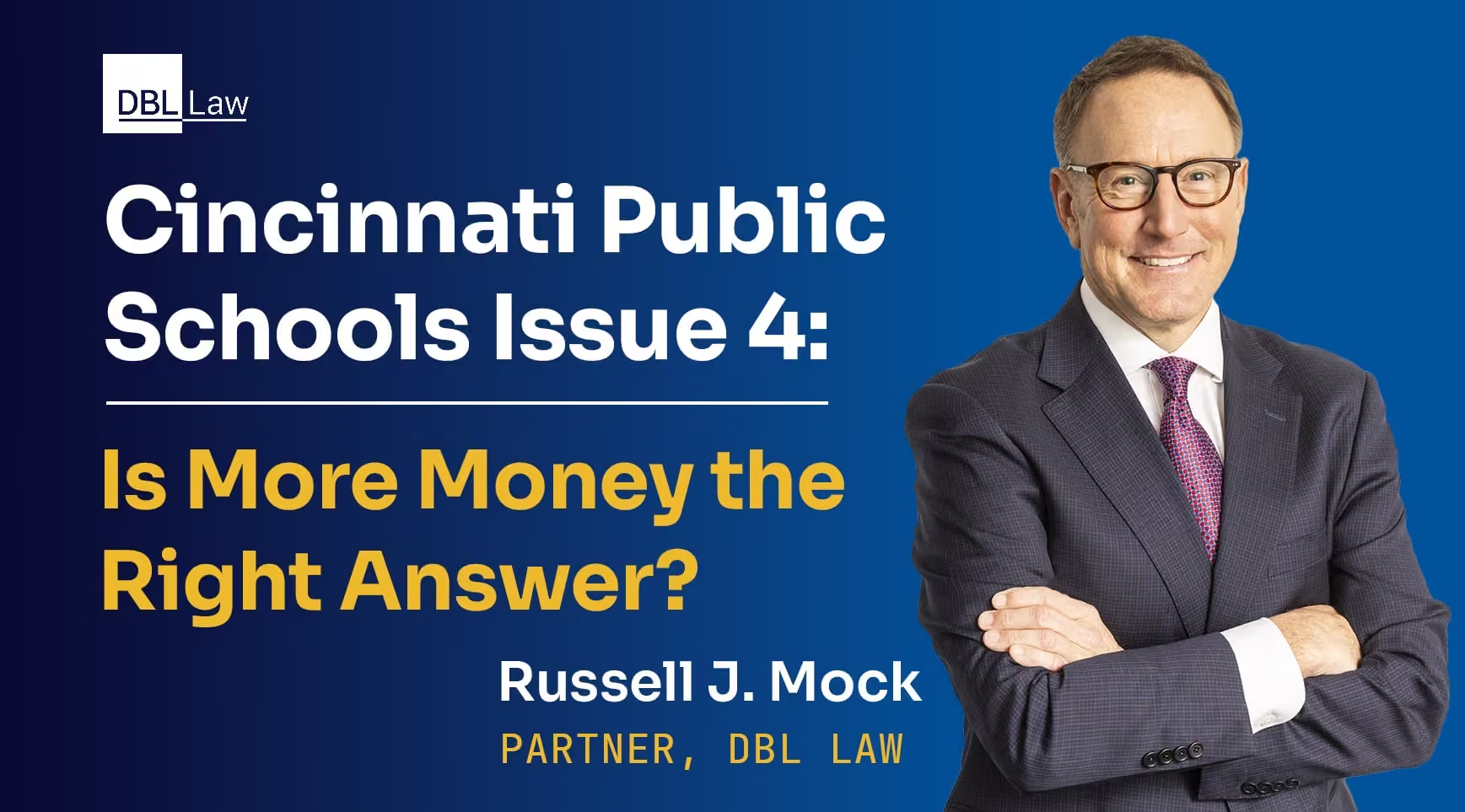

By: Russell J. Mock | Partner, DBL Law
On November 3, Cincinnati voters will decide Issue 4, a proposed property tax levy for Cincinnati Public Schools (CPS). The measure has generated considerable discussion among school officials, parents, business leaders, and taxpayers, with differing perspectives on the district’s financial needs, its management of existing resources and the potential impact on residents.
At its core, Issue 4 presents a question that extends beyond whether public education deserves adequate funding. Few would dispute that it does. The more difficult question is whether providing CPS with an additional $66.3 million annually represents the most responsible and effective way to address the district’s financial challenges.
As with any issue involving public funding, voters should understand not only what is being requested, but also why it is needed, how existing resources have been managed and whether additional taxpayer dollars are likely to produce the intended results.
During my 17 years serving as a trial and appellate judge, I learned the importance of examining the facts, considering competing arguments and understanding the consequences of a decision. Those same principles apply to the decisions we make as voters. Whether you ultimately support or oppose Issue 4, an informed decision requires more than accepting the arguments presented by either side.
Understanding Issue 4
Issue 4 proposes an additional five-year, 7-mill property tax levy to support the operating expenses of Cincinnati Public Schools. If approved, the levy would generate approximately $66.3 million annually, beginning with tax collections in 2027.
The revenue would support the district’s everyday operations, including teachers and staff, instructional programs, transportation, student services and facilities maintenance. Importantly, this is a new tax rather than a renewal of an existing levy.
Earlier this year, CPS considered a 0.75% earned-income tax before changing course in August following concerns expressed by community members. The district ultimately elected to place the property tax proposal on the November ballot.
Under the current proposal, property owners would pay an estimated additional $245 annually for every $100,000 of their property’s market value as determined by the county auditor. For example, a home valued at $200,000 would see an estimated increase of $490 per year, while a $300,000 home would see an increase of approximately $735. These amounts represent the proposed levy alone and would be added to existing property tax obligations.
For homeowners already facing increasing property taxes and other household expenses, that additional cost is not insignificant. The financial burden of the proposal deserves consideration alongside the district’s stated needs.
Why Is Additional Funding Being Requested?
According to district officials, CPS has gone approximately 10 years without requesting new operating funds from voters. During that period, costs associated with transportation, utilities, insurance, technology, instructional materials and student services have increased.
The district also reports that it has taken steps to address a projected $58 million budget shortfall through staffing reductions, spending controls, furloughs and other operational changes.
Although those measures helped balance the district’s fiscal year 2027 budget, school leaders maintain that the underlying financial challenges remain. Supporters of Issue 4 argue that additional recurring revenue is necessary to sustain educational programs, maintain staffing levels and provide students with the resources they need.
Those are legitimate concerns. A school district cannot operate effectively without adequate resources, and financial uncertainty can have consequences for students, teachers and families. But the existence of financial challenges does not, by itself, establish that additional taxation is the appropriate solution.
Voters are entitled to ask how the district arrived at its present financial condition. Were the challenges primarily the result of rising costs beyond the district’s control, decisions made by district leadership, structural problems in school funding or some combination of those factors? Have existing resources been allocated efficiently? What meaningful changes have been made to ensure that additional revenue would be managed effectively?
These questions are not intended to diminish the district’s needs. Rather, they are essential to understanding whether the proposed levy addresses the underlying problems or simply provides additional funding without sufficiently resolving them.
More Funding or Better Management?
Perhaps one of the most important questions surrounding Issue 4 is whether CPS has demonstrated that it can effectively manage the additional money it is requesting.
The proposed levy would generate approximately $331.5 million over five years, assuming annual collections meet the district’s estimate. That is a substantial commitment by Cincinnati taxpayers.
Before making that commitment, voters should reasonably expect a clear explanation of how the money would be spent, which expenses would receive priority and what measurable improvements or operational stability the district expects to achieve.
It is also fair to ask whether the district has sufficiently examined alternatives to raising taxes. Have opportunities for administrative efficiencies, consolidation of underutilized facilities, restructuring of operations or changes in spending priorities been fully evaluated? What savings have already been achieved, and what additional savings might be possible?
Of course, cost reductions are not without consequences. Eliminating positions, consolidating schools or reducing services can affect students and families, sometimes significantly. Those consequences deserve careful consideration. But so does the alternative of asking taxpayers to provide additional funding.
The question is not whether CPS should have the resources necessary to educate its students. It is whether the district has presented a sufficiently convincing case that the requested additional resources will be used responsibly and effectively. Supporting public education and demanding financial accountability should not be viewed as competing objectives. In fact, they should go hand in hand.
What About the Business Community’s Concerns?
Another consideration is the process CPS followed before placing Issue 4 on the ballot, particularly its engagement with Cincinnati’s business community.
Historically, major public funding initiatives in Cincinnati have often involved consultation with business and community leaders, including discussions about financial needs, spending priorities and potential alternatives. When CPS last sought new funding in 2016, business leaders played a significant role in developing support for the initiative. That history makes the concerns surrounding the current proposal particularly relevant.
The Cincinnati Business Committee, Cincinnati Regional Business Committee and Cincinnati Regional Chamber have raised objections to the timing and planning of Issue 4. Their concerns have included the district’s decision to move from a proposed income tax to a property tax, the absence of a sufficiently developed financial strategy and what they view as inadequate engagement with community stakeholders before proceeding with the levy.
Article: Cincinnati Business Courier: CPS property tax levy fight heats up with ex-school board member leading opposition
In correspondence with CPS leadership, these organizations urged the district to reconsider the timing of the proposal and undertake additional planning and community engagement. CPS leadership has maintained that efforts were made to collaborate with business leaders and that the district’s financial circumstances require additional revenue.
This disagreement raises a legitimate question for voters: Was the business community given a meaningful opportunity to review the district’s financial condition, evaluate alternatives and offer recommendations before CPS committed to placing the levy on the ballot? And if the district departed from the collaborative approach used in prior funding initiatives, what was the reason?
Consultation with business leaders does not mean that they should control decisions about public education. Those decisions ultimately belong to the elected Board of Education and, in this instance, the voters. Nevertheless, seeking advice from individuals and organizations experienced in managing substantial budgets and making difficult financial decisions can provide an important perspective.
The business community’s concerns should not automatically determine the outcome of the debate, any more than the district’s request for additional funding should be accepted without examination. Both deserve consideration.
Before asking taxpayers to commit more than $330 million over five years, it is reasonable to expect CPS to explain what steps it took to obtain independent input, evaluate alternatives and build community support for the proposal. Transparency about that process is an important part of public accountability.
Article: Cincinnati Enquirer: Cincinnati’s students deserve a plan for success | Opinion
What Happens If the Levy Passes or Fails?
A vote in favor of Issue 4 would authorize the additional five-year property tax levy, providing CPS with an estimated $66.3 million in annual operating revenue. A vote against Issue 4 would reject the proposed additional tax. The district’s existing funding would remain in place, but it would not receive the new revenue requested through this measure.
CPS officials have cautioned that without additional recurring funding, future budget decisions could involve school consolidation, larger class sizes, reduced transportation services, fewer extracurricular opportunities and additional staffing or operational changes.
Those potential consequences should be taken seriously. However, voters should distinguish between reductions that are unavoidable and those that represent choices among competing budget priorities. They should also understand which consequences are reasonably anticipated, and which remain possibilities rather than finalized decisions.
Equally important, voters should consider what passage of the levy would actually accomplish. Would the additional revenue place CPS on a sustainable financial footing for the next five years? Would it eliminate the need for further operating reductions? Would it address structural budget problems, or might those same problems resurface despite the new revenue? And perhaps most importantly, what assurances do taxpayers have that an additional $66.3 million annually will produce a better financial outcome than the district has achieved with its existing resources?
Passage of the levy would provide additional money. It would not, by itself, guarantee better management, improved educational outcomes or long-term financial stability. Those results depend upon how the money is used and the decisions made by district leadership.
Conversely, rejection of the levy would not eliminate the district’s financial challenges. It would require CPS to address those challenges without the proposed additional revenue, potentially resulting in difficult decisions affecting students, teachers and families. Neither outcome is without consequences, and neither should be evaluated solely through the campaign messaging of its supporters or opponents.
Accountability Should Be Part of the Discussion
In my experience, sound decisions require more than identifying a problem. They require evaluating whether the proposed solution is likely to solve it. That principle applies equally to public funding.
When an organization requests additional financial resources, it is reasonable to examine its past performance, its present financial condition, and its plans for the future. Public school districts should not be exempt from that scrutiny simply because their mission is important.
Indeed, the importance of educating our children makes responsible financial management even more essential. CPS leadership has an obligation to explain not only why additional revenue is needed, but also what taxpayers can reasonably expect in return. That explanation should include meaningful financial transparency, clearly identified spending priorities and measurable standards by which the district’s performance can be evaluated.
The district publishes financial reports, undergoes audits, and operates under the oversight of an elected Board of Education. Those are important accountability mechanisms. Voters may nevertheless reasonably ask whether additional commitments or more specific performance measures should accompany a funding request of this magnitude.
At the same time, voters should recognize that public education cannot be measured solely by financial considerations. Schools serve students with differing educational, social, and developmental needs, and providing those services involves costs that cannot always be reduced without affecting the quality of education.
The challenge is finding the appropriate balance between adequate educational funding and responsible stewardship of public money.
The Importance of Making an Informed Decision
During my years on the bench, I was frequently required to evaluate competing arguments, sometimes involving difficult choices and imperfect solutions. The obligation was not to accept the most compelling presentation at face value, but to examine the evidence supporting it.
Voters should approach Issue 4 with that same mindset.
The district’s assertion that additional funding is necessary deserves consideration. So do concerns about its management of existing resources, the burden on taxpayers, the extent of consultation with business and community leaders and whether the proposed levy represents a sustainable solution.
Before voting, residents should ask whether CPS has provided sufficient information to justify the additional expense. They should consider whether the district has demonstrated meaningful efforts to control costs, whether reasonable alternatives have been explored and whether there is a credible plan for managing the new revenue.
They should also consider the consequences for students and families if the levy fails. These are not questions with necessarily simple answers. Reasonable people may examine the same information and reach different conclusions. But asking difficult questions about public spending is not an expression of opposition to public education. It is an essential part of responsible citizenship.
Your Vote, Your Decision
Issue 4 presents Cincinnati voters with a significant decision involving public education, taxpayer resources and the future of the school district.
The importance of supporting our schools is undeniable. But the importance of that mission does not eliminate the need to examine how public money is spent, whether appropriate alternatives have been considered or whether additional funding represents the best solution to the challenges CPS faces.
The question before voters is not simply whether Cincinnati Public Schools could benefit from more money. It is whether CPS has demonstrated that giving it more money is the right decision. That determination should include consideration of the district’s financial needs, its management of existing resources, its willingness to seek input from community stakeholders and its plans for ensuring accountability if the levy is approved.
As November 3 approaches, I encourage voters to review the actual ballot language, understand the financial implications and carefully consider the arguments offered by both supporters and opponents. An informed electorate should expect accountability from those entrusted with public resources, just as it should recognize the importance of providing students with a quality education.
Your vote is your decision. Make sure it is an informed one.
About Russell J. Mock
Russ Mock brings nearly three decades of legal experience to DBL Law, including 17 years serving as a trial and appellate judge. A trusted advisor, connector and problem-solver, Russ draws on his extensive judicial and legal experience to help clients navigate complex legal matters, resolve disputes and find practical solutions.
Learn more about Russell J. Mock, his experience and his practice at DBL Law.