


When a government agency or other authorized entity seeks to take private property for a public project, property owners can quickly find themselves navigating an unfamiliar and highly technical legal process.
Kentucky law gives certain governmental entities, utilities and other organizations the power of eminent domain, but that authority is not unlimited. Property owners have important rights throughout the condemnation process, including the right to challenge whether a taking is legally permissible and the right to receive just compensation for property that is taken.
Understanding those rights early can make a significant difference.
What Is Eminent Domain?
Eminent domain is the government’s power to take private property for a public use. That power can also be delegated by the Kentucky legislature to certain entities, including cities, counties, utilities, transportation agencies, airports and railroads.
A taking does not necessarily mean acquiring an entire property. Eminent domain may involve a full ownership interest, a permanent easement for utilities or infrastructure, or a temporary easement needed during construction.
Regardless of the form of the taking, two fundamental requirements apply: the taking must be for a legitimate public use, and the property owner must receive just compensation.
What Is “Just Compensation”?
In Kentucky, just compensation generally is determined by comparing the fair market value of the entire property immediately before the taking with the fair market value of the property that remains afterward.
That makes valuation one of the most important and frequently disputed aspects of an eminent domain case.
The property’s current use is not necessarily the end of the analysis. Kentucky law allows consideration of uses for which the property is reasonably suitable, including its highest and most profitable potential use. A taking that affects access, development potential, configuration or future use can therefore have consequences extending beyond the value of the acreage actually acquired.
For that reason, experienced appraisers and, when appropriate, engineers, architects and land-use professionals can play an important role in evaluating the effect of a proposed taking.
Property Owners Should Pay Close Attention to the Process
Before filing a condemnation action, a condemning authority generally has a duty to negotiate in good faith with the property owner.
If an agreement cannot be reached and a condemnation action is filed, Kentucky’s Eminent Domain Act establishes a specific court process. Commissioners are appointed to evaluate the property and determine an initial compensation award. The property owner then has opportunities to challenge both the condemnor’s right to take the property and the amount of compensation.
Those opportunities come with important deadlines.
For example, a property owner wishing to challenge the condemnor’s legal right to take must generally raise that issue promptly after being served. Separately, a party seeking to challenge the commissioners’ compensation award must file exceptions within the statutory deadline.
Failing to act in time can result in the loss of important rights.
Valuation Is Often the Heart of the Case
When the amount of compensation is disputed, eminent domain cases frequently become contests between valuation experts.
Appraisers may consider comparable property sales, a property’s ability to generate income and, in some circumstances, the cost of replacing improvements. The analysis may also consider the property’s highest and best use and how the taking affects the value and utility of the remaining property.
Importantly, Kentucky eminent domain law does not treat every financial impact to a business as separately compensable. For example, lost business profits generally are not recoverable as a separate element of damages. Instead, the focus remains on the effect of the taking on the fair market value of the real estate.
That distinction makes a thorough evaluation of the property, the proposed taking and the resulting impact especially important.
Early Advice Can Matter
Eminent domain cases can move quickly, and decisions made early in the process may affect a property owner’s options later.
Property owners facing a potential condemnation should carefully evaluate the scope of the proposed taking, the authority of the condemning entity, the effect on the remaining property and whether the compensation being offered reflects the property’s true before-and-after value.
Understanding the process before accepting an offer or responding to a condemnation proceeding can help property owners make informed decisions and protect their rights.
About the Author
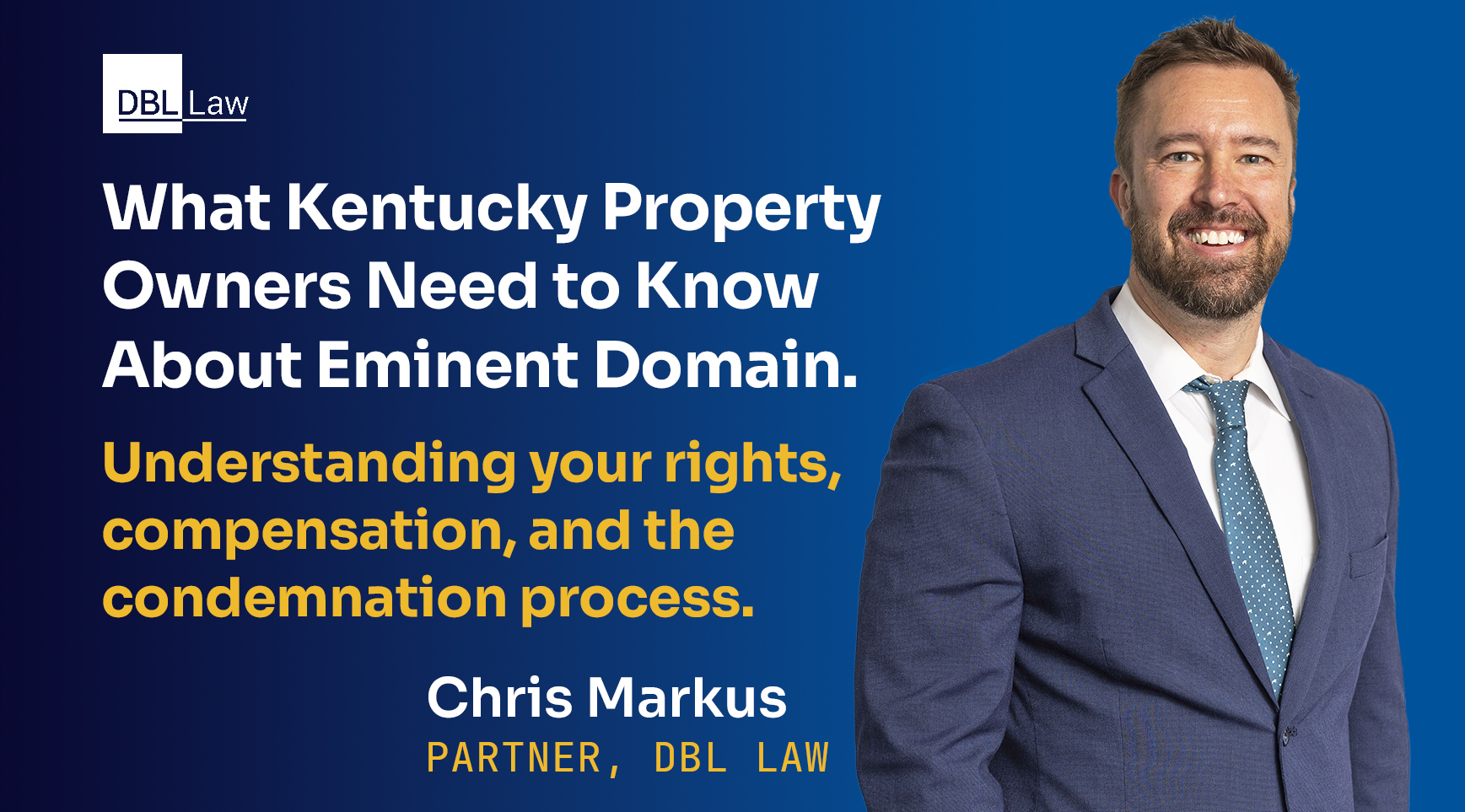
Chris Markus is a Partner at DBL Law and a member of the firm’s Eminent Domain and Litigation & Dispute Resolution practice groups. He represents clients in complex litigation matters and has served as the Owners’ Counsel of America Kentucky Representative since 2022, assisting private property owners in eminent domain and takings matters.
If your property is subject to a potential taking or condemnation proceeding, DBL Law’s Eminent Domain Team can help you understand your rights, evaluate the proposed taking and compensation, and determine the best path forward. Contact Chris Markus to learn more.